

Swedish automotive and embedded software companies develop increasingly complex products involving interconnected hardware, software, system requirements, and verification activities. When requirements are disconnected from design, development, and testing, engineering teams can struggle to assess changes, identify coverage gaps, and maintain consistent product information.
Requirements traceability helps connect these engineering activities throughout the product lifecycle. With IBM Engineering Lifecycle Management (ELM), organizations can establish relationships between requirements, system models, development tasks, and test results to improve engineering visibility and change management.
For Swedish engineering companies, the goal is to build a traceability process that supports product quality, collaboration, and efficient development without adding unnecessary administrative work.
Why Requirements Traceability Matters in Swedish Automotive and Embedded Engineering
Automotive and embedded products often involve multiple engineering disciplines. A vehicle control unit, industrial controller, or connected device may include system requirements, software requirements, hardware interfaces, embedded firmware, and extensive verification activities.
When these elements are managed in separate tools, engineers may not have a clear view of how requirements are implemented and verified.
Common challenges include:
- Requirements maintained in spreadsheets or disconnected systems.
- Incomplete links between system and software requirements.
- Test cases that are not associated with the requirements they verify.
- Difficulty identifying the impact of requirement changes.
- Limited visibility into verification status and unresolved defects.
- Manual preparation of engineering evidence and reports.
- Coordination challenges across distributed R&D teams and suppliers.
These issues can increase engineering effort and make it harder to maintain consistency throughout long product development cycles.
A structured approach to requirements traceability helps teams understand the relationships between engineering artifacts and investigate changes more effectively.
What Is Requirements Traceability?
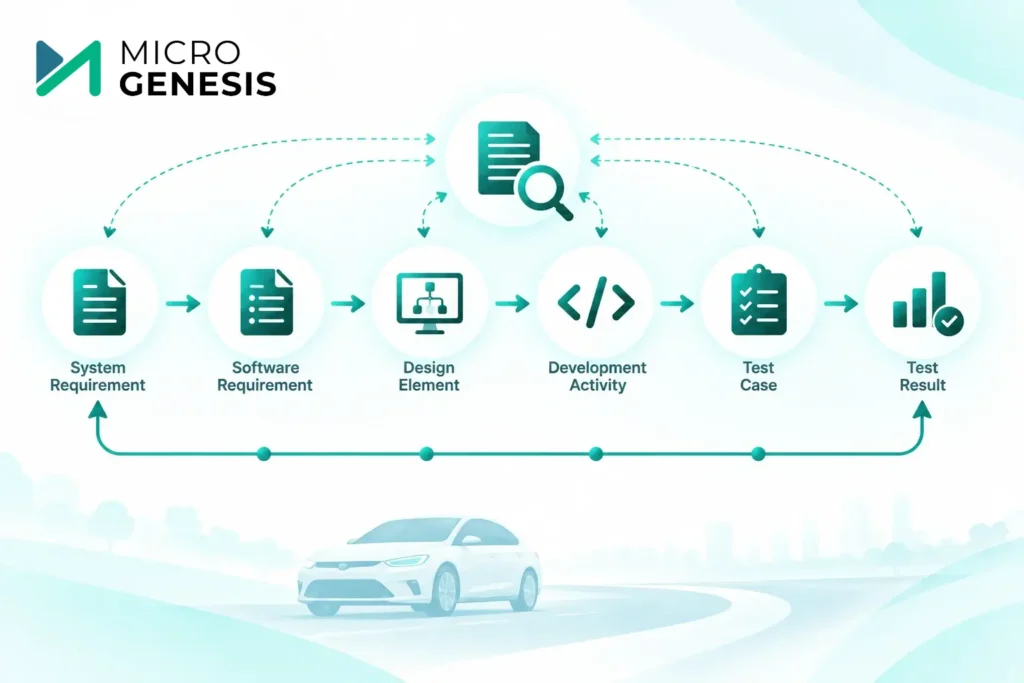
Requirements traceability is the ability to establish and maintain relationships between requirements and the engineering artifacts associated with their implementation and verification.
A typical traceability chain may include:
System Requirement → Software Requirement → Design Element → Development Activity → Test Case → Test Result
The precise relationships depend on the product architecture, engineering methodology, and organizational processes.
For example, an automotive software requirement may specify how a controller should respond to a particular operating condition. That requirement may connect to a system design element, a development task, and one or more test cases.
When the requirement changes, engineers can use these relationships to investigate affected activities and determine what needs to be reviewed, implemented, or retested.
For Swedish engineering organizations, traceability should be treated as an ongoing lifecycle practice rather than a document prepared only before a review or release.
1. Establish a Consistent Requirements Management Process
The first step toward better traceability is establishing a consistent approach to requirements management.
Engineering teams may use different templates, naming conventions, attributes, and approval processes across projects. These differences can make it difficult to compare requirements, maintain relationships, and generate consistent reports.
Organizations should define how requirements are created, reviewed, approved, changed, and retired.
Standardize requirements structures
Establish suitable categories for system requirements, software requirements, interface requirements, and verification criteria. Define relevant attributes, ownership, status values, and review procedures.
The structure should reflect the organization’s engineering processes rather than introduce unnecessary complexity.
Establish clear ownership
Each requirement should have an appropriate owner responsible for its accuracy, review, and maintenance.
Clear responsibilities help prevent outdated requirements and incomplete relationships from remaining unnoticed.
Maintain requirement versions
Engineering teams should be able to distinguish approved requirements from proposed changes and historical versions. Version control and change history help establish which requirements were applicable at a particular stage of development.
IBM Engineering Requirements Management DOORS Next supports structured requirements management and traceability workflows.
MicroGenesis provides IBM DOORS Next services to support requirements configuration, relationship management, and lifecycle traceability.
2. Connect Requirements with Systems Engineering and Design
Requirements describe what a product or system must achieve. Systems engineering defines how system components interact and how the product architecture supports those requirements.
In embedded engineering, a requirement may affect multiple hardware and software components. Without relationships between requirements and design information, engineers may need to investigate these dependencies manually.
IBM Engineering Systems Design Rhapsody supports model-based systems engineering and software design. Depending on the implementation, organizations can establish connections between requirements and relevant model elements.
Improve visibility across system components
Consider an embedded automotive controller containing sensors, communication interfaces, and software components. A change to one system requirement may affect several elements of the design.
Linking requirements to relevant design information helps engineers understand these relationships and assess the implications of changes.
Support multidisciplinary engineering
Swedish automotive and industrial engineering companies often coordinate systems engineers, hardware specialists, embedded developers, and verification teams.
Connecting requirements with design information helps teams understand how their work relates to system-level objectives.
Explore IBM Rhapsody services for support with systems engineering and model-based engineering workflows.
3. Link Requirements to Development Activities
Requirements traceability becomes more useful when engineering teams can connect approved requirements with the work needed to implement them.
If development tasks are managed independently, teams may struggle to determine which requirements a task supports and which activities need attention after a change.
IBM Engineering Workflow Management (EWM) supports work item management, development coordination, and change tracking.
Establish relationships between requirements and work items
Where appropriate, development tasks should be associated with the relevant requirements and design activities.
These relationships help engineering leads understand implementation progress and identify work that may be affected when requirements change.
Improve change coordination
A controlled change process should record the reason for a change, its approval status, affected requirements, assigned tasks, and necessary verification activities.
For example, changing an embedded software requirement may require updates to implementation tasks and associated test cases. Maintaining the relationships makes it easier to coordinate these activities.
MicroGenesis provides IBM Engineering Workflow Management services to support development workflows and engineering change management.
For organizations looking to improve this process, simplifying engineering change management with IBM ELM is a closely related consideration.
4. Connect Requirements to Test Cases and Verification Results
A requirement is not fully managed simply because it has been documented and implemented. Engineering teams also need to establish how its intended behaviour will be verified.
Requirements-based testing connects each requirement to appropriate verification activities.
Maintain test coverage
Test cases should be linked to the requirements they are intended to verify. This helps teams identify requirements without associated tests and assess whether the planned verification activities cover the expected behaviour.
Track verification status
Test execution records help teams identify which tests have passed, failed, or remain incomplete.
When test results are associated with requirements, engineers can investigate whether a failure affects a particular requirement or a broader part of the system.
Support regression testing
A requirement or design change may affect previously validated functionality. Traceability helps teams identify relevant test cases and determine the appropriate regression testing scope.
IBM Engineering Test Management supports test planning, test case management, execution, and verification information.
Explore IBM Engineering Test Management services to understand how test management can support connected engineering workflows.
For Swedish MedTech organizations, strengthening requirements traceability and verification in MedTech is particularly relevant when linking requirements, test activities, and engineering evidence. Traceability can support quality processes, but compliance still depends on the organization’s procedures and validation activities.
5. Improve Engineering Tool Integration
Requirements, design, development, and testing information often resides in different engineering tools. Without suitable integrations, teams may need to copy information manually or maintain duplicate records.
This can introduce inconsistencies and make it difficult to establish reliable traceability across the lifecycle.
An effective integration strategy should identify which engineering artifacts need to be connected and how those relationships will be maintained.
Assess the existing toolchain
Before implementing integrations, review the current requirements management, systems engineering, development, and testing environments.
Determine which tools should remain in place, which relationships need to be maintained, and where manual processes create the greatest operational challenges.
Define integration responsibilities
The integration design should clarify data ownership, synchronization behaviour, access controls, error handling, and maintenance responsibilities.
Integrations should be tested against realistic engineering scenarios, particularly where changes in one system must be reflected in related engineering activities.
For Swedish organizations with distributed R&D teams and external suppliers, connected information can improve collaboration and reduce dependence on manual status updates.
Reducing engineering data silos across distributed R&D teams is an important consideration when planning how requirements and verification information will be shared across tools and teams.
6. Establish a Structured Change-Impact Analysis Process
Engineering changes are inevitable in automotive and embedded software development. Requirements may evolve because of design changes, customer needs, defect findings, hardware constraints, or updated product specifications.
Without traceability, identifying the full impact of a change can require considerable manual investigation.
A structured change-impact analysis process should help teams identify:
- The requirement being changed.
- Related system and software requirements.
- Affected design elements and interfaces.
- Development work items that may require updates.
- Test cases that need review or execution.
- Approvals and documentation required before release.
IBM ELM can support this process when relationships between the relevant engineering artifacts are established and maintained.
For example, changing a communication requirement in an embedded controller may affect interface definitions, software implementation, and integration tests. Traceability provides a starting point for identifying these dependencies.
However, tool-generated relationships do not replace engineering judgement. Teams must review the identified impacts and determine which actions are necessary.
7. Support Automotive and Embedded Engineering Requirements
Swedish automotive and embedded software companies operate in engineering environments where product complexity, hardware-software dependencies, and verification requirements can make traceability challenging.
A practical traceability strategy should account for the specific needs of each engineering environment.
Automotive software development
Automotive teams may need to connect system requirements, software requirements, architecture, development activities, and verification results across multiple components.
A structured approach helps engineers investigate changes and maintain visibility into the status of requirements and their associated tests.
Embedded systems
Embedded software often depends on hardware interfaces, timing constraints, communication protocols, and device-specific behaviour.
Traceability should account for these relationships where they are relevant to implementation and verification.
Industrial automation
Industrial systems may involve controllers, connected devices, control software, and long product maintenance periods.
Consistent requirements and change records can help engineering teams understand how modifications affect system behaviour and verification activities.
The appropriate implementation should reflect the organization’s architecture, lifecycle, and quality processes.
8. How to Implement Requirements Traceability with IBM ELM
A successful traceability initiative requires more than enabling links between engineering artifacts. Organizations should define the process, configure the tools, establish ownership, and train users.
A practical implementation approach includes:
Assess existing processes: Identify how requirements, design, development, and testing information is currently managed.
Define traceability objectives: Determine which relationships are necessary for engineering visibility, change management, and verification.
Standardize requirements: Establish consistent structures, attributes, ownership, and review processes.
Configure engineering tools: Set up the relevant IBM ELM capabilities and relationships.
Integrate the toolchain: Connect the engineering systems required to support the defined workflows.
Validate traceability: Test representative scenarios, including requirement changes and verification failures.
Train users: Explain how teams should create, review, and maintain relationships.
Monitor and improve: Review missing relationships, outdated records, and opportunities to simplify workflows.
Organizations can begin with a pilot project and expand the approach once the configuration and process have been validated.
The implementation scope should depend on the current environment, number of tools, migration requirements, and complexity of engineering relationships.
Why Choose MicroGenesis for IBM ELM Services in Sweden?
MicroGenesis supports engineering organizations with IBM ELM consulting, implementation, integration, migration, configuration, and ongoing lifecycle management services.
With 25+ years of experience and 400+ clients globally, MicroGenesis helps organizations address requirements management, traceability, engineering integration, and connected development workflows.
Services can include:
- IBM ELM consulting and implementation: Assess current processes and define an appropriate implementation strategy.
- IBM DOORS Next services: Support requirements structures, relationships, reviews, and traceability.
- IBM Rhapsody services: Support systems engineering and model-based engineering workflows.
- IBM Engineering Workflow Management services: Configure development workflows and change management.
- IBM Engineering Test Management services: Support test planning, execution, and verification traceability.
- Engineering integration and migration: Connect tools and support the transition from existing environments.
- Ongoing optimization: Improve configurations, workflows, and lifecycle visibility.
Organizations evaluating a partner should also consider how to choose an IBM ELM partner in Sweden, including implementation experience, integration capabilities, migration expertise, training, and long-term support.
The appropriate service scope depends on your existing engineering environment, technical requirements, and business objectives.
Frequently Asked Questions
What is requirements traceability in automotive software development?
Requirements traceability connects system and software requirements with relevant design elements, development activities, test cases, and verification results. It helps teams assess coverage and investigate changes throughout the engineering lifecycle.
How can IBM DOORS Next improve requirements traceability?
IBM DOORS Next supports structured requirements management and relationships between engineering artifacts. When configured and maintained appropriately, these capabilities can help teams manage requirement changes and improve visibility into downstream engineering activities.
Can IBM ELM connect requirements with testing?
Yes. Depending on the tools and integration design, IBM ELM can connect requirements with test cases and execution results, helping teams assess verification coverage and investigate failures.
Is requirements traceability important for embedded systems?
Yes. Embedded products can involve complex interactions between hardware, software, interfaces, and timing requirements. Traceability helps engineering teams understand these relationships and assess the impact of changes.
Does implementing IBM ELM guarantee compliance?
No. IBM ELM can support traceability and controlled engineering workflows, but compliance depends on the organization’s processes, documentation, validation, and applicable requirements.
Conclusion
Improving requirements traceability helps Swedish automotive and embedded software companies establish stronger connections between requirements, system design, development, and testing.
IBM ELM provides capabilities for managing requirements, coordinating development, supporting systems engineering, and maintaining verification information. However, effective traceability depends on appropriate configuration, integration, defined responsibilities, and consistent engineering practices.
MicroGenesis supports organizations with IBM ELM consulting and implementation services, including DOORS Next, Rhapsody, Engineering Workflow Management, and Engineering Test Management.
For Swedish engineering teams seeking better lifecycle visibility, more structured change management, and reliable requirements-to-test relationships, a well-planned traceability strategy can provide a practical foundation for improving engineering processes.