

Medical technology companies developing software-enabled medical devices must manage complex requirements, design decisions, software changes, and verification activities throughout the product lifecycle. For Swedish MedTech organizations, maintaining clear relationships between these engineering activities is important for product quality, risk management, and demonstrating that a device meets its specified requirements.
As medical devices become increasingly connected and software-intensive, requirements may be distributed across product specifications, risk management records, system architecture, software development activities, and test documentation. When these artifacts are maintained in disconnected systems, teams can struggle to understand whether requirements have been implemented, whether appropriate verification has been completed, and how a change affects the rest of the product.
Requirements traceability provides a structured way to connect these activities. IBM Engineering Lifecycle Management (ELM), including capabilities for requirements management, systems engineering, development workflow management, and test management, can help organizations establish relationships between engineering artifacts.
For Swedish MedTech companies, the objective is to create a reliable, maintainable traceability process that supports engineering decisions and quality processes without introducing unnecessary administrative effort.
Why Requirements Traceability Matters in MedTech
Medical device development involves more than documenting product functionality. Engineering teams must consider intended use, system behaviour, software requirements, risk controls, design decisions, and verification evidence.
The specific obligations depend on the device, its intended use, applicable regulations, and the organization’s quality management system. However, maintaining consistent engineering information is important across many medical device development environments.
1. Requirements are distributed across engineering activities
A medical device may have user needs, system requirements, hardware requirements, software requirements, interface specifications, and verification criteria.
When these elements are managed separately, teams may find it difficult to establish whether lower-level requirements adequately address higher-level needs.
2. Verification coverage is difficult to assess
A requirement may be documented and implemented but still lack an appropriate verification activity.
Without reliable links between requirements and test cases, teams may need to review multiple documents manually to identify missing coverage or incomplete verification.
3. Changes can affect multiple parts of the device
A change to software behaviour, an interface, or a system requirement may affect related requirements, risk controls, design elements, and test cases.
If these relationships are not maintained, engineering teams may overlook activities that require reassessment.
4. Engineering evidence becomes difficult to maintain
Teams may need to demonstrate how requirements were addressed and how the product was verified. When information is spread across disconnected files and tools, preparing consistent records can require considerable manual effort.
5. Distributed teams need consistent engineering information
MedTech development may involve systems engineers, software developers, quality professionals, verification teams, and external development partners.
A consistent approach to traceability helps these stakeholders understand the status of requirements, changes, and verification activities.
What Is Requirements Traceability in Medical Device Development?
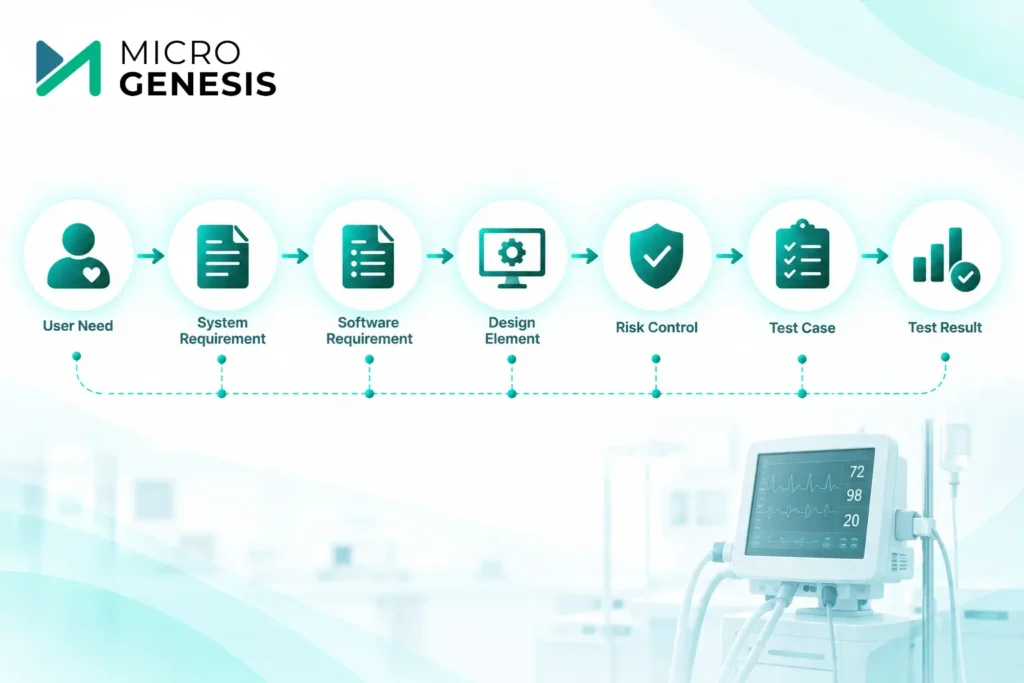
Requirements traceability is the ability to establish and maintain relationships between requirements and the engineering artifacts associated with their implementation, risk management, and verification.
A representative traceability chain may look like this:
User Need → System Requirement → Software Requirement → Design Element → Risk Control, Where Applicable → Test Case → Test Result
The exact structure depends on the device and development process. Not every requirement will have the same relationships, and some engineering relationships may require additional review or justification.
A well-maintained traceability structure helps teams answer important questions:
Which requirements address a particular user need?
How is a requirement reflected in the system or software design?
Which risk controls are associated with relevant requirements?
Which test cases are intended to verify a requirement?
Have the necessary verification activities been completed?
What may be affected when a requirement changes?
Traceability should be maintained throughout development rather than assembled only when a review or audit is approaching.
1. Establish Structured Requirements Management with IBM DOORS Next
A reliable traceability process begins with structured requirements management.
IBM Engineering Requirements Management DOORS Next supports requirements management and relationships between requirements and other engineering artifacts. It can help teams organize requirements, maintain relevant attributes, and establish traceability across the lifecycle.
Organize requirements according to the development process
Define how user needs, system requirements, software requirements, interface requirements, and verification criteria should be represented.
The structure should reflect the organization’s engineering methodology and quality processes.
Define requirement attributes and ownership
Depending on the project, relevant attributes may include:
Requirement identifier and description.
Requirement type and priority.
Owner and review status.
Source or rationale.
Approval and version information.
Relationships to relevant engineering artifacts.
Consistent attributes make it easier to review requirements and understand their status.
Maintain relationships between requirements
Establish appropriate links between higher-level needs and the requirements intended to address them.
These relationships help engineers investigate whether requirements have been decomposed and connected appropriately. They do not, by themselves, prove that the requirements are correct or complete.
MicroGenesis provides IBM DOORS Next services to support requirements configuration, management, and lifecycle traceability.
2. Connect Requirements with Systems Engineering and Design
Requirements describe what a medical device must do, while systems engineering helps define how the device and its components fulfil those requirements.
For software-enabled medical devices, changes to system behaviour may affect interfaces, hardware components, embedded software, or other system elements.
IBM Engineering Systems Design Rhapsody supports model-based systems engineering and software design workflows. Depending on the configured environment, organizations can establish relationships between requirements and relevant model elements.
This can help engineering teams:
Understand how requirements relate to system architecture.
Review dependencies between system components.
Investigate potential design impacts.
Coordinate systems engineering and software development.
Maintain visibility into relevant design information.
For example, a change to an interface requirement may affect software components and associated verification activities. Relationships between requirements and design elements can help engineers identify areas that require further investigation.
Explore IBM Rhapsody services for support with systems engineering and model-based engineering workflows.
3. Link Requirements to Risk Management Activities
Risk management is an important part of medical device development. Engineering teams need to understand how identified hazards, hazardous situations, and risk control measures relate to product requirements and design decisions.
The relationships required depend on the organization’s risk management process and the applicable standards and regulations.
Where appropriate, traceability can connect relevant risk control measures with requirements, implementation artifacts, and verification activities.
This helps teams investigate whether:
A risk control has been translated into an appropriate requirement.
The relevant requirement has been implemented.
Verification activities address the intended risk control.
A proposed change may affect an existing risk control.
Additional assessment or verification may be required.
For example, changing software that contributes to a risk control may require a review of the associated requirements, implementation, and tests.
IBM ELM can support connected engineering information, but it does not replace risk analysis, clinical or safety judgement, or the organization’s quality management procedures.
4. Strengthen Requirements Verification with IBM Engineering Test Management
Requirements traceability is incomplete if teams cannot determine how requirements are verified.
IBM Engineering Test Management (ETM) supports test planning, test case management, execution, and verification information. When configured appropriately, it can help organizations connect requirements with relevant test cases and execution results.
Establish requirement-to-test relationships
Each requirement should have suitable verification criteria and an appropriate verification approach where verification is required.
Linking requirements to test cases helps teams identify requirements with no associated tests and assess whether the planned verification activities address the expected behaviour.
Track test execution and results
Verification status should be based on recorded execution results and defined acceptance criteria.
Engineering teams need visibility into tests that have passed, failed, remain incomplete, or require investigation.
Review verification coverage after changes
A requirement change may affect existing test cases or introduce additional verification needs.
Maintained relationships help engineers identify relevant tests for review. The team must still determine which tests should be updated or repeated based on the nature and impact of the change.
MicroGenesis provides IBM Engineering Test Management services to support test management and connected verification workflows.
5. Maintain Traceability Across Software Development Activities
Software requirements often need to be connected with implementation tasks, defects, change requests, and related engineering activities.
IBM Engineering Workflow Management (EWM) supports work item management, development coordination, and change tracking.
When development activities are linked to the relevant requirements, engineering teams can improve visibility into implementation status and understand which tasks are associated with a change.
A connected workflow may help teams:
Assign implementation work to responsible engineers.
Track the status of development activities.
Link work items to relevant requirements.
Coordinate fixes and changes.
Identify outstanding work before verification or release.
For example, a software requirement may need changes across multiple components. Linked work items help teams coordinate implementation and understand which activities remain incomplete.
Explore IBM Engineering Workflow Management services for support with development workflow configuration and change management.
6. Implement a Structured Requirements Traceability Matrix
A requirements traceability matrix provides a structured view of relationships between requirements and selected engineering artifacts.
Depending on the project, it may connect user needs, system requirements, software requirements, risk controls, design elements, and test cases.
The matrix can help teams identify gaps, but its usefulness depends on accurate underlying information and appropriate review procedures.
What should the matrix include?
The structure should reflect the device and its development process. Relevant fields may include:
Requirement identifier.
Requirement description or reference.
Parent or source requirement.
Related design or implementation artifact.
Relevant risk control, where applicable.
Associated verification method or test case.
Verification status.
Review or approval status.
Use traceability to identify gaps
A traceability review can help identify requirements without suitable verification links, tests without clear requirement coverage, or relationships that require further investigation.
Teams should define how such gaps are assessed and resolved.
Where the engineering toolchain supports it, traceability views and reports can reduce the effort needed to identify missing relationships. They should supplement, rather than replace, technical review.
7. Establish a Repeatable Change-Impact Analysis Process
Requirements and design changes are inevitable during medical device development. A change may be introduced because of testing results, defect investigation, updated product needs, design refinement, or a revised risk assessment.
A structured change-impact process should identify the engineering artifacts that may be affected before the change is implemented and verified.
A practical process includes:
Record the change request and its justification.
Identify the requirements and design elements involved.
Review relationships to related requirements and risk controls.
Identify affected development tasks and test cases.
Assess whether additional verification or documentation is required.
Obtain the appropriate technical and quality approvals.
Implement the change and complete required verification.
Record the outcome and update affected engineering information.
IBM ELM can support this process when the relevant relationships and workflows are configured and maintained.
For organizations seeking to improve this capability, simplifying engineering change management with IBM ELM is a closely related area to consider.
8. Integrate Engineering Tools and Reduce Data Silos
Medical device engineering information may be maintained in requirements management, systems engineering, development, testing, risk management, and quality management environments.
Integration can help reduce duplicate data entry and establish more reliable connections between relevant artifacts.
Before implementing integrations, assess the existing toolchain and identify:
Which system is authoritative for each type of information.
Which relationships need to be maintained.
Which data needs to be synchronized.
How changes and conflicting updates should be handled.
Which access controls and security requirements apply.
How integration failures will be detected and resolved.
Not every system needs to be replaced or fully synchronized. The integration strategy should focus on the information flows needed to support engineering and quality processes.
This is particularly relevant when reducing engineering data silos across distributed R&D teams working across locations, suppliers, and specialized applications.
9. Build a Sustainable Traceability Process
A traceability system is only as useful as the information maintained within it.
Organizations should establish clear responsibilities and regular review practices to prevent relationships from becoming incomplete or outdated.
Define ownership
Assign responsibility for requirements, design relationships, test cases, and change records. Make it clear who can create, approve, and update each type of information.
Establish review criteria
Define when traceability relationships must be reviewed—for example, during requirements reviews, design changes, verification planning, and release preparation.
Train users
Provide practical guidance for engineers, testers, and other stakeholders on how to create relationships and record verification outcomes consistently.
Monitor meaningful indicators
Useful indicators may include:
Percentage of applicable requirements with associated verification activities.
Number of requirements with unresolved traceability gaps.
Outstanding verification activities.
Changes awaiting impact assessment.
Open defects associated with requirements.
Age of unresolved traceability issues.
Metrics should be defined carefully. A high percentage of linked requirements does not automatically mean the links are correct or that verification is adequate.
How MicroGenesis Can Support IBM ELM Implementation in Sweden
Implementing requirements traceability across a MedTech engineering environment requires more than configuring a tool. Organizations need a suitable lifecycle structure, appropriate integrations, defined responsibilities, and processes that fit their quality and engineering requirements.
MicroGenesis supports engineering organizations with IBM ELM consulting, implementation, configuration, integration, migration, training, and ongoing support.
With 25+ years of experience and 400+ clients globally, MicroGenesis helps organizations address requirements management, engineering integration, development workflows, and verification challenges.
Support can include:
IBM ELM consulting and implementation: Assess current processes and plan an appropriate lifecycle management approach.
IBM DOORS Next services: Support structured requirements management and traceability.
IBM Rhapsody services: Support systems engineering and model-based engineering workflows.
IBM Engineering Workflow Management services: Configure development coordination and change tracking.
IBM Engineering Test Management services: Support test planning, execution, and verification relationships.
Engineering integration and migration: Connect relevant tools and support transitions from existing environments.
Training and ongoing support: Help teams maintain consistent workflows and improve the engineering environment.
The appropriate solution depends on the device development process, existing tools, integration requirements, and quality management procedures.
Organizations evaluating implementation support should also consider choosing an IBM ELM implementation partner in Sweden, including experience with requirements management, integration, migration, and long-term support.
Frequently Asked Questions
Why is requirements traceability important for MedTech companies?
Requirements traceability helps connect user needs and product requirements with design, implementation, risk management, and verification activities. It can improve visibility into engineering coverage and help teams investigate changes.
How can IBM DOORS Next support medical device requirements management?
IBM DOORS Next supports structured requirements management and relationships between requirements and other engineering artifacts. With suitable configuration and governance, it can help teams maintain traceability throughout development.
Can IBM ELM help connect requirements with risk controls and test cases?
IBM ELM capabilities can support relationships between relevant engineering artifacts, depending on the tools and integration design. Organizations must define and validate the relationships needed for their risk management and verification processes.
Does implementing IBM ELM guarantee medical device regulatory compliance?
No. IBM ELM can support requirements traceability and engineering evidence management, but regulatory compliance depends on the applicable requirements, the organization’s quality management system, validated processes, and the adequacy of its records and activities.
How can a MedTech company identify traceability gaps?
Teams can review requirements-to-design relationships, risk control relationships where applicable, and requirements-to-test links. Traceability views and reports can help identify missing or incomplete relationships, which should then be assessed and resolved by the responsible teams.
Can requirements traceability support engineering changes?
Yes. Maintained relationships help teams identify potentially affected requirements, design elements, implementation tasks, and tests. Engineering and quality personnel must evaluate the actual impact and determine the required actions.
Conclusion
For Swedish MedTech companies, effective requirements traceability connects product needs, engineering decisions, implementation activities, and verification results throughout the development lifecycle.
IBM ELM can help organizations establish these connections through requirements management, systems engineering, development workflow management, and test management. Its value depends on suitable configuration, reliable data, appropriate integration, and consistent engineering practices.
MicroGenesis supports organizations with IBM ELM consulting and implementation services to help establish connected engineering workflows.
For medical device development teams looking to improve lifecycle visibility and verification management, a structured traceability strategy can provide a practical foundation for stronger engineering processes and more consistent evidence management.